The Pentangle’s Fivefold Virtues
Sir Gawain and the Green KnightThe Pentangle’s Fivefold Virtues is the interlaced five-pointed figure painted in gold on Sir Gawain’s red shield. The poem presents it as a sign of truth and as an emblem fitted to Gawain’s character and arms: its endless, interlocking form gives visible shape to ideals of fidelity and virtue. Its importance lies not only in what the shield displays, but in the demanding standard against which Gawain’s conduct can be read.
Design and Meaning
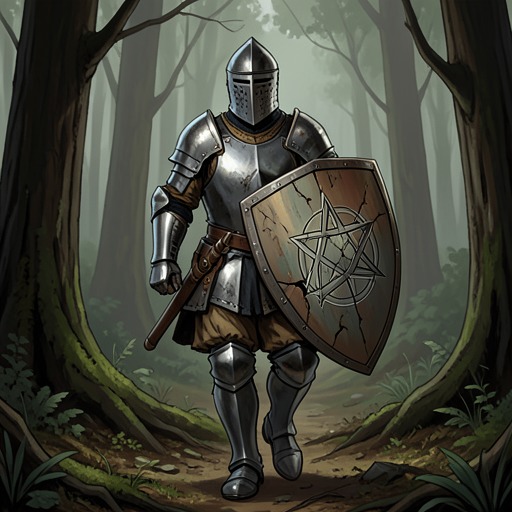
The shield is shown in a bright red field, with the pentangle painted in pure gold. Gawain carries it by a baldric cast around his neck, so the emblem is presented as part of his equipment and as a conspicuous mark of the knight setting out on his adventure. The narrator pauses over its meaning rather than treating the device as merely decorative: the figure has five points, and each line winds through and locks with the others. The design has no final break; the poem calls it an endless knot.
The account associates the sign with Salamon, who set it as a token of truth because of the qualities its form possesses. The lines’ continuous interlacing makes the emblem a fitting image for constancy: each part belongs to a connected pattern, and the pattern does not simply terminate at one point. The narrator explicitly says that this sign suits Gawain and his shining arms. Its appearance therefore carries an interpretation within the story, connecting the visible shield to an ethical ideal rather than leaving its significance to guesswork.
The Fivefold Correspondences
The poem develops the pentangle through linked groups of five. Gawain is described as faultless in his five senses and as never failing in his five fingers. The account also sets his faith in relation to the five wounds, bringing bodily faculties and Christian devotion into the same pattern. These are not identical kinds of qualities: the senses and fingers evoke capacities of the body, while faith points toward a spiritual standard. The emblem gathers them into one design without erasing their differences.
A further fivefold group concerns Gawain’s conduct. The poem names generosity and fellowship above all, and describes his cleanliness and courtesy as never crooked. These qualities make the shield’s sign social as well as personal: the ideal is expressed not only through inward truth or bodily capability, but through how a knight behaves toward others. The narrator’s description of the interlaced figure and the catalogue of Gawain’s qualities reinforce one another. The design joins separate lines into an enduring whole; the account likewise presents his virtues as mutually sustaining parts of a reputation for fidelity.
An Ideal Carried into the Adventure
The pentangle appears within the poem’s larger presentation of adventure. The narrator announces an extraordinary tale associated with the wonders of King Arthur, and the early account recalls Arthur’s youthful desire to hear of adventures. When Gawain rides away, the emblem travels with him from the courtly world into a deep, wild forest. It thus accompanies a knight whose reputation has been carefully set out in advance, at the moment that reputation must meet the uncertainties of a journey.
That placement gives the shield’s ideal a narrative function. The poem does not merely identify Gawain as virtuous and move on; it supplies a visible standard before the adventure tests what a knight can sustain. The pentangle’s interdependence and endlessness make its promise especially exacting. A reader can measure conduct against the emblem because the narration has explained what it signifies and why it belongs to Gawain. Its role is therefore both heraldic and interpretive: it marks the knight, while also establishing the terms on which his actions acquire meaning.
The Green Girdle and the Limits of the Sign
The later Green Girdle offers a pointed contrast in the poem’s use of objects. The text says that whoever is girt with the green lace, while it is held close around him, cannot be cut down by any man beneath heaven. At the end, Gawain’s neck wound is healed, and he wears the shining belt bound at his side like a baldric. The belt is thus connected to bodily protection and to the aftermath of the encounter, while the pentangle on the shield has been explained as a sign of truth and a pattern of virtue.
This contrast does not make the two objects interchangeable. The shield bears an ideal whose interwoven lines signify fidelity; the belt is associated with protection from a physical blow and returns visibly on Gawain’s person after his neck has been wounded. Read together, they place the poem’s ethical emblem beside an object bound to vulnerability and survival. The pentangle’s force comes from the high standard it makes legible; the belt’s force comes from the danger it is said to avert and from its place in the ending. The poem’s careful explanation of the shield ensures that Gawain’s adventure is measured not only by what he carries, but by the meaning attached to it.